
Millwork vs. Casework: Key Differences Every Contractor Should Know
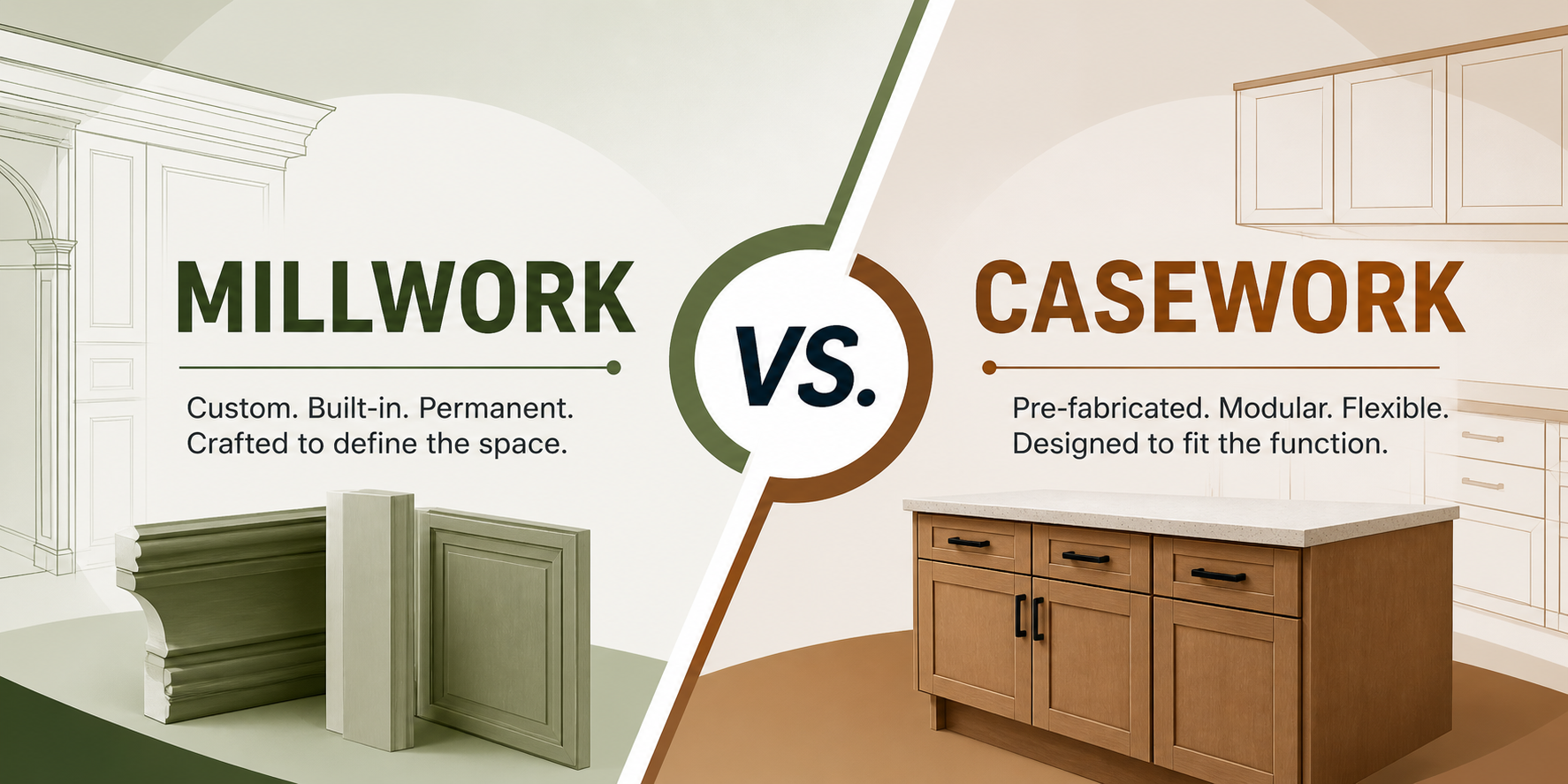
Millwork refers to custom-fabricated wood products built to specific architectural dimensions think panelling, mouldings, staircases, and bespoke built-ins. Casework refers to pre-engineered or modular box-based units such as cabinets, shelving, and storage systems. The key difference: millwork is site-specific and custom; casework is standardised and modular. Both require precise shop drawings to manufacture and install correctly.
Introduction: Why Contractors Keep Mixing These Up
Understanding the difference between millwork vs casework is one of the most practical things a contractor, architect, or interior designer can do before a project hits the shop floor. These two terms appear together on nearly every interior specification yet they describe fundamentally different products, fabrication processes, and vendor scopes.
If you've been in construction long enough, you've likely seen a project specification that uses "millwork" and "casework" interchangeably and watched it cause confusion during submittal reviews, fabrication, and installation.
Treating them as synonyms leads to wrong vendor selections, scope gaps, incorrect drawings, and costly rework on the job site.
This guide breaks down the real millwork vs casework difference clearly, practically, and in the language contractors, architects, and interior designers actually use on commercial and residential projects.
What Is Millwork? (Definition and Scope)
Millwork is any architectural woodwork product that is custom-fabricated to fit the specific dimensions and design intent of a project. The name comes from the traditional "mill" where wood components were shaped and processed.
Millwork is almost always:
- Custom-made to project-specific dimensions and profiles
- Architecturally significant — it contributes to the visual design of the space
- Site-specific — designed around the exact conditions and tolerances of the building
Common Millwork Examples
- Decorative mouldings (crown, base, chair rail, casing)
- Wall panelling and wainscoting
- Coffered ceilings
- Custom staircases and railings
- Built-in bookshelves and entertainment units
- Custom doors, frames, and transoms
- Reception desks and feature walls
- Architectural columns and pilasters
Where Is Millwork Used?
Millwork is most common in high-end residential construction, hotel interiors, corporate headquarters, religious institutions, educational facilities, and any project where the interior wood detailing is an architectural feature not just a functional one.
What Is Casework? (Definition and Scope)
Casework refers to modular or semi-custom box-based storage units essentially cabinetry and enclosures that store, organise, or conceal things. The word "case" refers to the box structure that forms the unit.
Casework is typically:
- Box-based — constructed from panels forming a rectangular enclosure
- Modular — built in standard dimensions that can be configured to fit a space
- Functional-first — designed primarily for storage and utility
Common Casework Examples
- Kitchen base and wall cabinets
- Bathroom vanities
- Laboratory casework and workstations
- Hospital nurse stations and storage
- Retail display shelving
- Educational storage lockers
- Commercial office credenzas and built-in storage
Where Is Casework Used?
Casework is the standard in healthcare facilities, educational buildings, laboratories, retail environments, and commercial offices anywhere function, durability, and cost efficiency matter more than bespoke aesthetics.
Millwork vs. Casework: Side-by-Side Comparison
| Feature | Millwork | Casework |
|---|---|---|
| Definition | Custom architectural woodwork | Modular box-based cabinetry |
| Design Approach | Site-specific and custom | Standardised and configurable |
| Fabrication | Custom mill shop | Cabinet or case manufacturer |
| Primary Purpose | Aesthetic and architectural | Functional storage |
| Complexity | High profiles, mouldings, details | Moderate box construction |
| Cost | Higher (custom labour) | Lower to moderate |
| Lead Time | Longer | Shorter |
| Standards | AWI, NKBA, WI | AWI, NKBA, SEFA (labs) |
| Drawings Required | Millwork shop drawings + details | Shop drawings + elevations |
| Examples | Panelling, mouldings, staircases | Cabinets, nurse stations, lab benches |
Key Differences Explained
1. Custom vs. Modular Construction
This is the most fundamental difference. Millwork is built around your project. Every dimension, profile, and joint is tailored to the space. Casework starts with standard box dimensions and is configured or modified to fit.
A custom reception desk built to match an architect's elevation drawing? That's millwork. The storage cabinets behind the desk that come in standard 24-inch widths? That's casework.
2. Aesthetic Role vs. Functional Role
Millwork is meant to be seen and admired. It is an architectural element. The quality of craftsmanship in millwork directly reflects the design quality of the space.
Casework is meant to work. It stores things, organises things, and hides things. While casework can be well-designed, its primary job is function.
3. Fabrication and Vendor Selection
These products often come from different suppliers. Millwork is produced by architectural millwork shops specialists in custom wood fabrication. Casework is produced by cabinet manufacturers or commercial case goods suppliers who work in volume.
Assigning a millwork scope to a casework manufacturer (or vice versa) is a common mistake that creates quality problems and change orders.
4. Drawing and Documentation Requirements
Millwork requires detailed shop drawings that show custom profiles, joinery methods, material specifications, and installation sequences. These drawings must be coordinated with architectural drawings, MEP, and structural documentation.
Casework shop drawings are generally simpler elevations, sections, hardware schedules, and finish specifications. However, in complex environments like healthcare or laboratory settings, casework drawings require careful coordination too.
This is why accurate, professionally produced millwork shop drawings and casework drawings are essential before fabrication begins. Errors at the drawing stage are far cheaper to fix than errors at the shop or on-site.
Where Millwork and Casework Overlap
In practice, many projects include both. A commercial interior might feature:
- Custom millwork panelling behind a reception desk (millwork)
- Built-in storage cabinets on either side of the reception (casework)
- Decorative mouldings and ceiling details throughout the lobby (millwork)
- Office kitchenette cabinetry (casework)
Some products exist in a grey zone. A custom built-in library unit, for example, may be specified as millwork by one architect and as high-end casework by another. What matters is how the specification defines it and that the drawings and fabrication reflect that definition accurately.
AWI Grades: How Standards Apply to Both
The Architectural Woodwork Institute (AWI) sets quality standards for both millwork and casework in the United States. There are three AWI grades:
- Economy Grade — Basic quality, suitable for utilitarian applications
- Custom Grade — Most common grade for commercial projects; good quality and consistency
- Premium Grade — Highest level of craftsmanship; used in high-end and visible applications
Both millwork and casework can be specified at any AWI grade. The grade must be defined clearly in the project specifications to avoid disputes between owner, contractor, and fabricator.
In the UK, similar guidance is provided through BS 4422 and the British Woodworking Federation (BWF) standards.
Why the Millwork vs. Casework Distinction Matters for Contractors
Getting millwork and casework right at the documentation stage before fabrication — is what separates smooth projects from chaotic ones.
Scope clarity — Is this a millwork contractor's scope or a cabinet supplier's scope? Ambiguity here creates gaps in bid packages and RFIs during construction.
Drawing accuracy — Millwork and casework require different levels of drawing detail. Millwork drawings must capture custom profiles, joinery methods, and material transitions. Submitting casework-level drawings for a millwork scope will fail the architect's review.
Coordination — Both millwork and casework must be coordinated with walls, floors, ceilings, MEP rough-ins, and adjacent trades. Missing that coordination at the shop drawing stage creates field conflicts.
Cost control — Specifying millwork where casework will do adds unnecessary cost. Specifying casework where millwork is required creates a design quality failure. Both are expensive mistakes.
How Professional Millwork Drafting Services Help
Whether you are managing a commercial fit-out, a residential renovation, or an institutional construction project, professional millwork drafting services bridge the gap between design intent and fabrication reality.
At Shalin Designs, the team produces:
- Millwork shop drawings with full elevation, section, and detail drawings
- Casework shop drawings with hardware schedules and material specifications
- CNC-ready DXF and NC files for automated fabrication
- Bill of materials and cut lists to support production planning
- AWI and NKBA compliant documentation for US projects
- BS-standard drawings for UK projects
Accurate shop drawings reduce fabrication errors, prevent site rework, and give every trade architects, fabricators, contractors, and installers the same clear documentation to work from.
Common Contractor Questions About Millwork vs. Casework
Can casework be custom?
Yes. Semi-custom and full-custom casework exists, but even custom casework follows a box-based construction approach. It is still fundamentally different from millwork in how it is designed and fabricated.
Is millwork always wood?
Not always. Modern millwork can incorporate MDF, HDF, veneers, metals, and glass but wood-based materials remain dominant. The term refers to the custom fabrication process as much as the material.
Do millwork shops do casework too?
Many do, particularly for integrated interior projects. However, their pricing and fabrication process for casework may differ from a dedicated cabinet manufacturer.
What is "architectural millwork"?
Architectural millwork is millwork that is a designed component of the building's architecture panelling systems, coffered ceilings, custom doors, and decorative elements that are drawn and specified by the architect of record.
Who approves millwork shop drawings?
Typically the architect of record, sometimes with input from the interior designer and the general contractor. Shop drawings must match the design intent drawings and comply with applicable AWI or BS standards.
Summary: Millwork vs. Casework at a Glance
- Millwork = custom, architectural, site-specific, complex, higher cost
- Casework = modular, functional, standardised, efficient, lower cost
- Both require accurate shop drawings before fabrication
- Both fall under AWI standards in the US and BS standards in the UK
- Confusing the two creates scope gaps, drawing errors, and costly rework
Need Professional Millwork or Casework Drawings?
Knowing the difference between millwork and casework is step one. Getting the drawings right before fabrication is what keeps projects on time and on budget.
Shalin Designs provides expert millwork drafting services for contractors, architects, interior designers, and fabricators across the USA and UK. With over a decade of experience producing fabrication-ready millwork shop drawings compliant with AWI, NKBA, and BS standards, the team delivers documentation that works on the shop floor not just on paper.

 English
 Arabic
 French
 Spanish
 Portuguese
 Deutsch
 Turkish
 Dutch
Dutch
 Italiano
 Russian
 Romaian
 Portuguese (Brazil)
 Greek
Greek
