Aluminum has become a cornerstone material in modern manufacturing due to its lightweight structure, corrosion resistance, and strength-to-weight advantages. However, joining aluminum efficiently and reliably remains one of the most technically challenging tasks in production environments. This is where an aluminum spot welder becomes essential delivering controlled, high-energy resistance welding designed specifically for aluminum’s unique electrical and thermal behavior.
For OEMs, automation integrators, and manufacturing engineers, selecting the right welding system is not just about joining metals it’s about ensuring production stability, weld consistency, and long-term structural performance.
What Is an Aluminum Spot Welder?
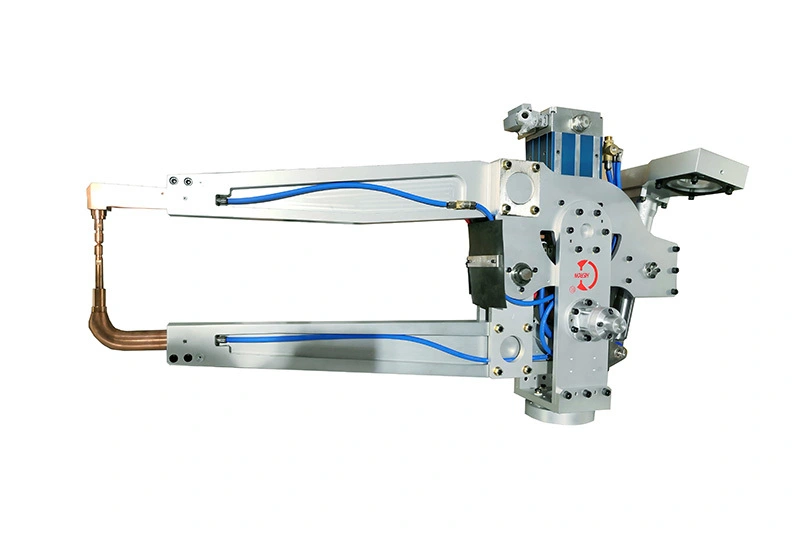
An aluminum spot welder is a specialized resistance welding machine designed to join aluminum sheets through localized heat generated by high electrical current and electrode pressure. Unlike steel, aluminum requires significantly higher current and more precise control due to:
- High electrical conductivity
- Fast heat dissipation
- Oxide layer resistance on the surface
The process forms a weld nugget at the interface of overlapping aluminum sheets, creating a solid-state metallurgical bond once cooled under pressure.
In industrial applications, modern aluminum spot welders especially MFDC (Medium Frequency Direct Current) systems are preferred for their precision, efficiency, and stability.
How Aluminum Spot Welding Works
The aluminum spot welding process follows a controlled three-stage cycle:
1. Squeeze Phase
Electrodes apply force to ensure tight contact between aluminum sheets. This reduces contact resistance variation caused by surface oxide layers.
2. Heating Phase
A high-amperage current passes through the workpiece. Due to resistance at the interface, localized heat melts the aluminum and forms a molten weld nugget.
Q=I2RtQ = I^2 R tQ=I2Rt
This equation explains the heat generation mechanism, where current (I) plays a critical role in aluminum welding performance.
3. Forging and Cooling Phase
The current stops while pressure is maintained. The molten metal solidifies under force, forming a dense, defect-free joint.
Why Aluminum Is Difficult to Spot Weld
Aluminum introduces unique engineering challenges that demand specialized welding systems:
1. High Electrical Conductivity
Aluminum dissipates heat quickly, requiring higher current (often 2–3× that of steel) to achieve fusion.
2. Oxide Layer Barrier
Aluminum naturally forms an oxide layer with a melting point far higher than the base metal, increasing resistance variability.
3. Thermal Loss
Heat spreads rapidly, reducing efficiency and making consistent weld nugget formation more difficult.
These factors make conventional AC spot welders less effective in industrial environments.
MFDC Technology: The Industry Standard for Aluminum Spot Welding
Modern aluminum spot welder systems rely heavily on MFDC (Medium Frequency Direct Current) technology for superior control and efficiency.
Key Advantages of MFDC Aluminum Spot Welders
- Stable DC output eliminates zero-crossing energy loss
- Precise current control improves weld consistency
- Reduced spatter and electrode wear increases tool life
- Better energy efficiency compared to traditional AC systems
- Higher repeatability for automated production lines
In high-volume manufacturing such as automotive or EV battery production, MFDC systems are now the preferred solution.
Industrial Applications of Aluminum Spot Welding
Aluminum spot welding is widely used across advanced manufacturing industries where lightweight construction and structural integrity are critical.
1. Automotive and Electric Vehicles
- Body-in-white structures
- EV battery trays
- Lightweight chassis components
2. Aerospace Engineering
- Aircraft panels
- Structural brackets
- Interior assemblies
3. Rail Transportation
- High-speed train panels
- Lightweight structural components
4. Industrial Equipment Manufacturing
- HVAC housings
- Electrical enclosures
- Precision fabricated assemblies
The demand for aluminum welding continues to grow as industries shift toward lightweight and energy-efficient designs.
Best Practices for High-Quality Aluminum Spot Welding
To achieve consistent weld quality, manufacturers must optimize several key process parameters:
1. Electrode Design and Maintenance
- Use larger diameter copper electrodes
- Ensure frequent dressing to maintain contact quality
2. Surface Preparation
- Remove oxide layers before welding
- Use controlled cleaning methods for repeatability
3. Parameter Optimization
- High current, short weld time strategy
- Proper force calibration to prevent expulsion
4. Automation Integration
- Real-time monitoring systems
- Adaptive welding control for production variability
Why Aluminum Spot Welding Requires Advanced Equipment
Unlike general metal joining processes, aluminum spot welding is highly sensitive to:
- Current fluctuations
- Electrode pressure variations
- Material thickness inconsistencies
This is why industrial manufacturers rely on advanced systems like those engineered by Heron Welder, which specialize in resistance welding technologies including:
- MFDC spot welding systems
- Automated welding production lines
- Welding guns and controllers
- Custom-engineered joining solutions
Heron’s solutions are designed to support high-precision manufacturing environments where consistency, speed, and reliability are non-negotiable.
Aluminum Spot Welder vs Traditional Welding Methods
Compared to TIG or MIG welding, aluminum spot welding offers:
- Faster production cycle times
- Lower consumable costs
- Easier automation integration
- Minimal post-processing requirements
However, it is best suited for sheet metal applications and not thick structural welds.
Why Choose Heron for Aluminum Spot Welding Solutions
Heron Welder provides engineered solutions for modern manufacturing challenges. Their aluminum spot welding systems are designed for:
- High-volume production efficiency
- Automotive-grade weld consistency
- Integration with robotic automation lines
- Long-term electrode durability and process stability
By focusing on resistance welding innovation, Heron helps manufacturers achieve scalable, repeatable, and high-strength aluminum joints across diverse industries.
FAQs About Aluminum Spot Welding
1. Can aluminum be spot welded effectively?
Yes, but it requires high-current resistance welding systems like MFDC machines to overcome aluminum’s conductivity and oxide layer.
2. Why is aluminum harder to spot weld than steel?
Because aluminum dissipates heat quickly and has a strong oxide layer that resists electrical flow.
3. What industries use aluminum spot welding?
Automotive, aerospace, rail transportation, and industrial manufacturing sectors widely use it.
4. What type of spot welder is best for aluminum?
MFDC (Medium Frequency DC) spot welders are the most effective for aluminum applications.
5. Is aluminum spot welding suitable for automation?
Yes, it is widely integrated into robotic welding systems for high-speed production lines.
Final Thoughts
The aluminum spot welder has become a critical technology in modern manufacturing, enabling industries to produce lightweight, durable, and high-performance components at scale. However, achieving consistent weld quality requires advanced control systems, optimized parameters, and specialized resistance welding technology.
With decades of expertise in industrial welding systems, Heron Welder delivers advanced aluminum spot welding solutions designed for precision, automation, and production efficiency.
Request a Custom Aluminum Spot Welding Solution
If you are looking to improve weld consistency, upgrade your production line, or integrate advanced aluminum welding technology, Heron Welder can help.
Contact Heron today to request a quote or consultation for customized aluminum spot welding and automation solutions tailored to your manufacturing needs.


 English
 Arabic
 French
 Spanish
 Deutsch
 Turkish
 Dutch
Dutch
 Italiano
 Russian
 Romaian
 Portuguese (Brazil)
 Greek
Greek
 Chinese
